


👋 Hey, welcome to Predicted, the newsletter covering the business of prediction markets.
Forwarded this email and want it in your inbox? Hit the subscribe button below! 👇
Discussed in this piece:
What compute markets are
Kalshi launched forward curves first
Polymarket's forward curve takes off
Where traders expect compute prices to go
AI model bets are still bigger
How big compute markets could get
What we are watching
This piece was written and researched by Omar El Safy and edited by Pet Berisha.
This week, Polymarket International put up a forward curve for compute, a list of what traders expect it to cost to rent Nvidia's ($NVDA ( ▼ 1.63% )) AI chips in each month out to December 2028.
Most AI companies rent these chips by the hour instead of buying them, and that rent moves a lot. An H100 cost more than $8 an hour in 2023 and around $3 by late 2025. It went from $1.76 in March 2026 to $3.14 in May 2026, and sat at $3.05 on 25 November 2026. For a lab renting 1,000 of them, every $1 move in the hourly rent comes to $8.76M a year.
To keep it simple, in this piece, compute means renting time on AI chips, and compute markets are the prediction markets that bet on that rent. Chips are the hardware itself, like Nvidia's H100.
Oil and electricity have futures markets where companies lock in next year's price. Compute doesn't have one yet.
Polymarket CEO Shayne Coplan announced it on X.
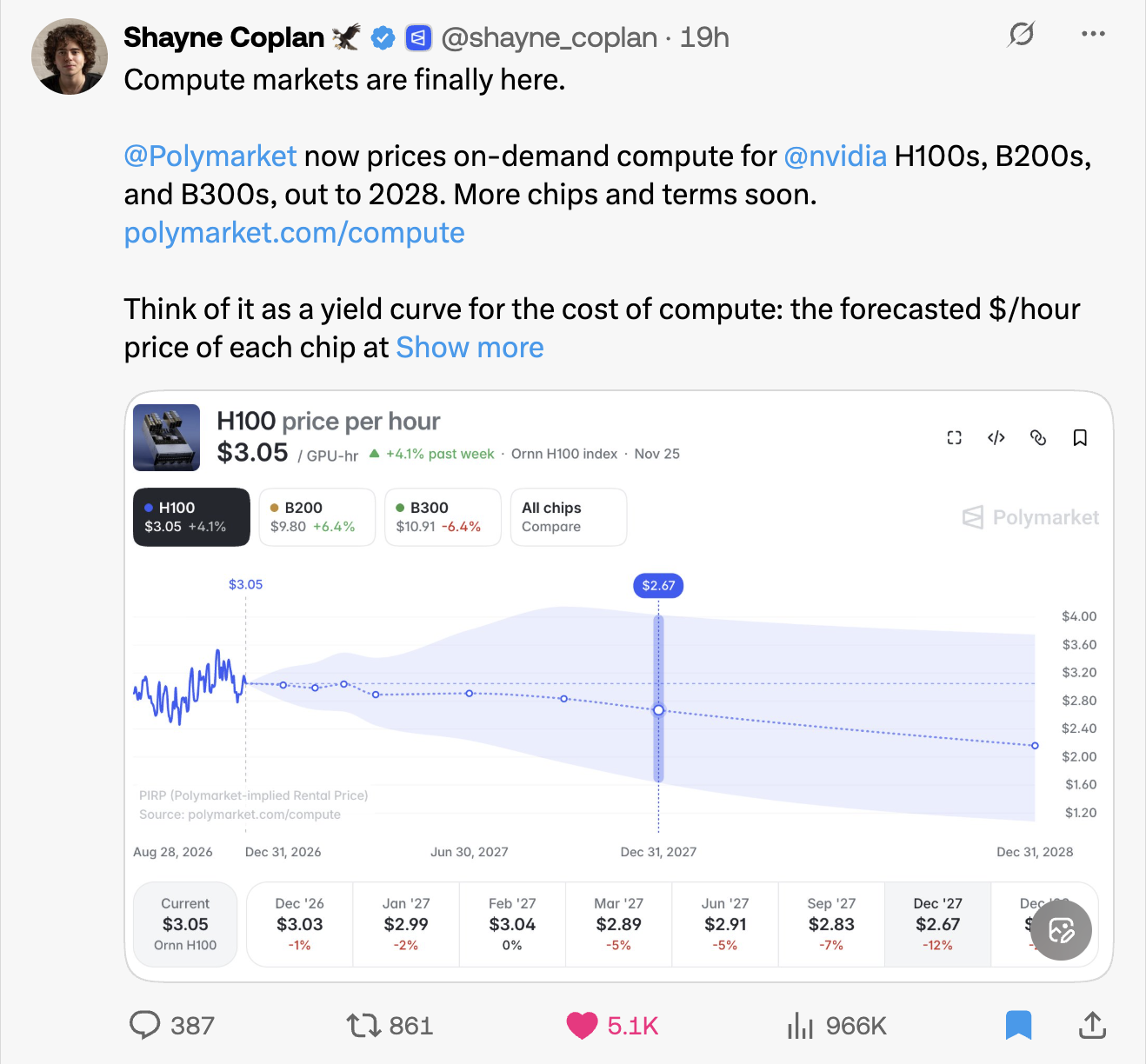
Fig. 1. Polymarket's H100 forward curve, as posted on 25 November 2026. Source: Shayne Coplan on X.
Kalshi published the first compute curve in July 2026 and took it down in August 2026. Polymarket's curve traded $6.0M of notional volume in its first three and a half days.
Before we get into things…
If you haven't read our Q3 2026 report yet, you should.
It's the most comprehensive Prediction Market report ever.
Read it for free below! 👇
01 - What compute markets are
Prediction markets list two main kinds of AI-related markets.
1) One asks which company will have the best AI model at the end of the month.
2) The other asks what it will cost to rent an AI chip.
Polymarket's international exchange listed the first compute markets in February 2026.
Each asked about a single day, for example "Will the Ornn H100 Index be less than $2.00 on October 31, 2026?" Ornn's index is a daily reading of what each chip rents for by the hour.
Kalshi followed in March 2026, with weekly, monthly and quarterly markets on five chips, from Nvidia's data-centre H100, H200, B200 and A100 to the RTX 5090, a graphics card gamers buy.
Polymarket US filed compute contracts with the Commodity Futures Trading Commission (CFTC) in August 2026 but has not listed them.
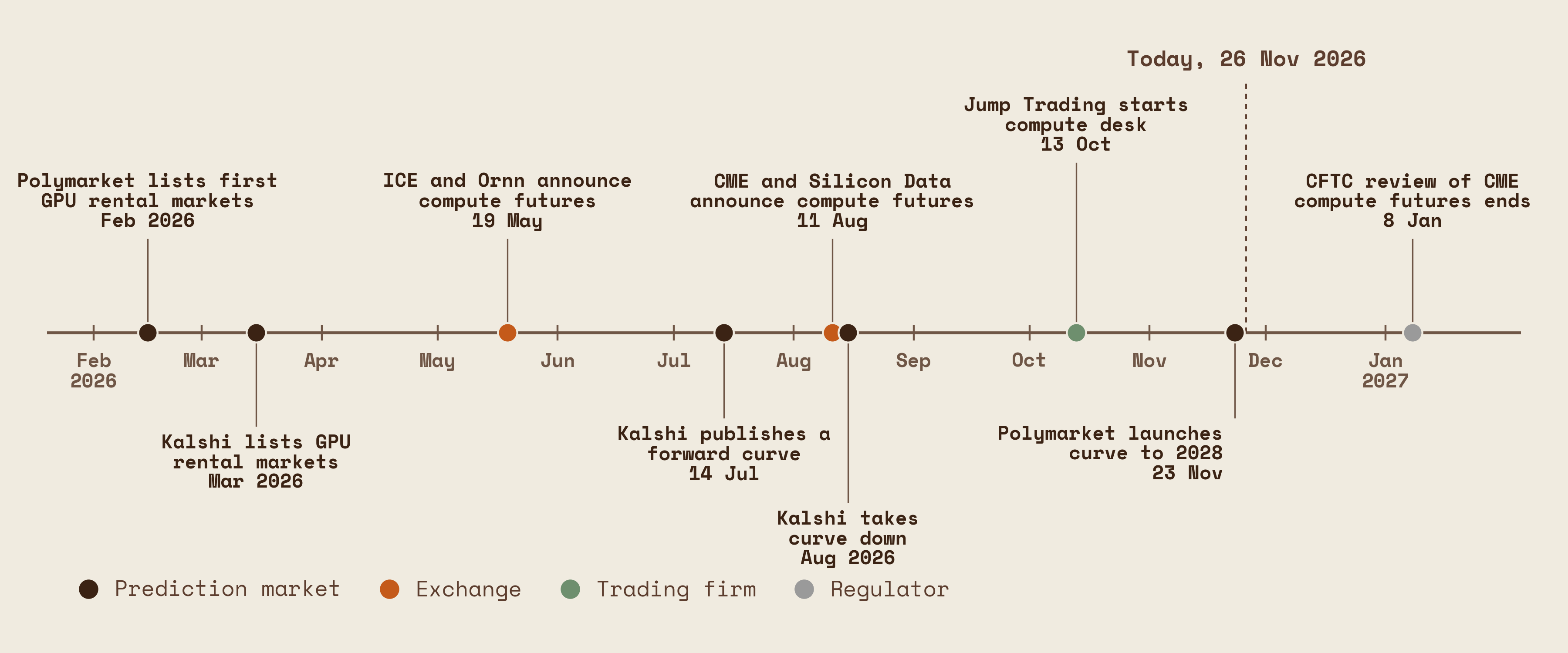
Fig. 2. Compute markets in 2026, from the first prediction markets to CME's pending futures. Source: The Prediction.
02 - Kalshi launched forward curves first
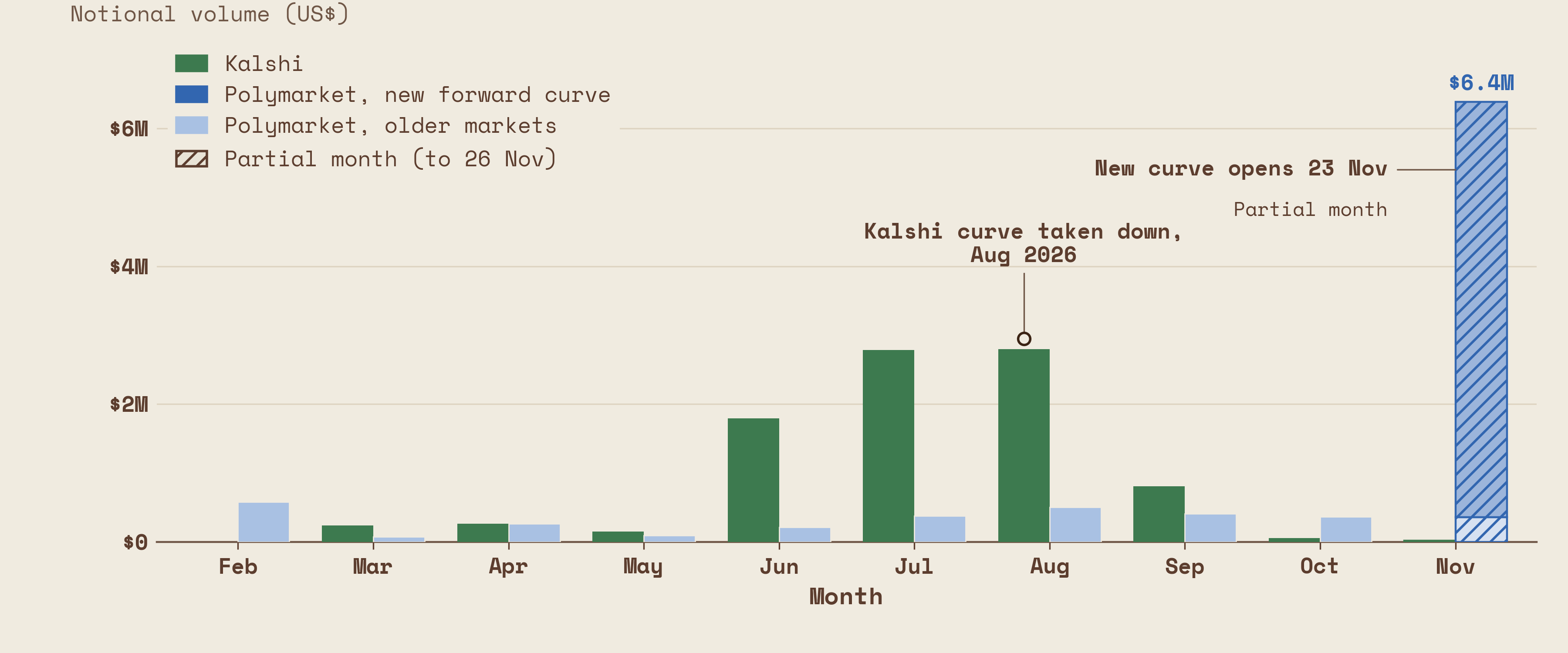
Fig. 3. Monthly notional volume of compute markets on Kalshi and Polymarket's international exchange. November 2026 runs to 26 November 2026. Source: The Prediction.
Kalshi's compute markets grew through the summer of 2026, to $2.79M of notional volume in July 2026 and $2.80M in August 2026.
The busiest were the H200, at $2.36M across 2026, and the RTX 5090 gaming card, at $2.32M.
On 14 July 2026, Kalshi turned those markets into a forward curve.
In August 2026, Commerce Department officials told Kalshi to take it down on national-security grounds, Semafor reported. The Commerce Department called the story false.
Kalshi took the curve down anyway and kept the markets open. Volume on them fell to $807K in September 2026 and $60K in October 2026, down 98% from August 2026.
Polymarket's older compute markets stayed between $0.2M-$0.5M in monthly volume, and in October 2026 they passed Kalshi at $369K vs $60K.
Kalshi's forward curves were clearly popular to trade, and Kalshi lost most of its compute-related volume when they removed them.
This is where Polymarket’s offshore exchange evidently has its advantages.
03 - Polymarket's forward curve takes off
Each of Polymarket's new compute markets asks a simple question about the rent in a future month.
For example, "Will the average Ornn H100 rental price in January 2027 be above $2.70?"
There is a question like that for each chip, for every month from December 2026 to December 2028, at 10 to 20 different prices. Combining the answers together, you get the curve.
Each one pays out on the average rent across the whole month, so one volatile day doesn’t distort pricing. Hence, a curve.
In three and a half days, traders put $6.0M of notional volume into these markets. That’s the equivalent of roughly half of the $11.8M every compute market on Kalshi and Polymarket traded in the ten months from January 2026 to October 2026 combined.
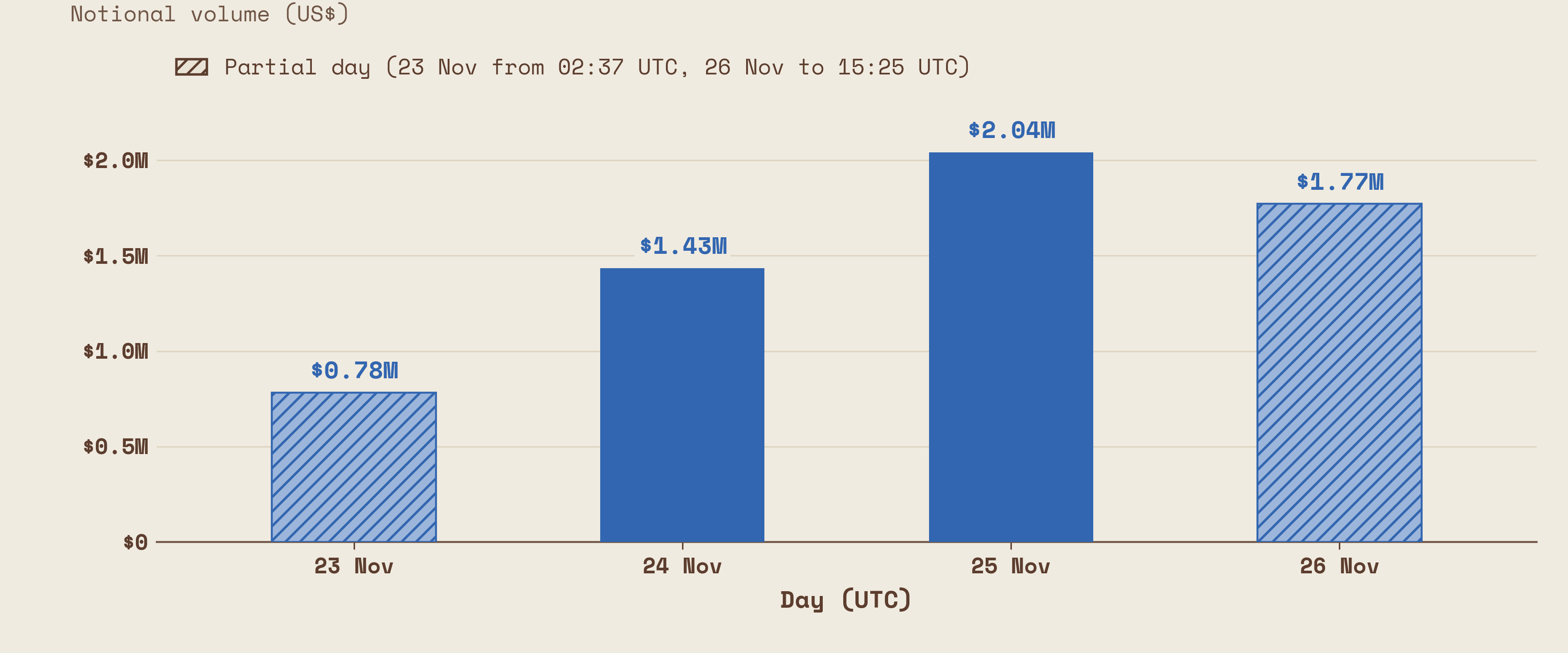
Fig. 4. Daily notional volume on Polymarket's compute curve. 23 November 2026 opened at 02:37 UTC and 26 November 2026 runs to 15:25 UTC. Source: The Prediction.
Some stats from the launch:
Daily volume grew from $0.78M on the first day to $2.04M on 25 November 2026.
564 wallets have traded the curve, and 406 of them never traded Polymarket's older compute markets.
The average trade put $359 of cash into the curve, compared to $21 on the older markets, and the ten biggest wallets account for 57% of the notional volume.
The biggest single trade came on 26 November 2026, when one wallet spent $118,587 at 65¢ a contract betting that B200 rent will average above $8 an hour in March 2027. That will pay out $183,514 if it does.
Our read is that a published curve brings in bigger, newer traders, and a handful of them account for most of the money so far.
04 - Where traders expect compute prices to go
Renting one H100 cost $3.05 an hour on 25 November 2026 on Ornn's index, the price Polymarket's markets pay out on.
Each market asks whether the average rent in a given month will be above a certain price. From those prices, we worked out the rent traders see as a 50-50 call for each month.
By that measure, traders expect the H100 to rent for about $2.71 an hour in December 2027 and $1.86 in December 2028, 39% below the current rent. They expect the newer B200 and B300 chips to get cheaper too, by 44% and 29%.
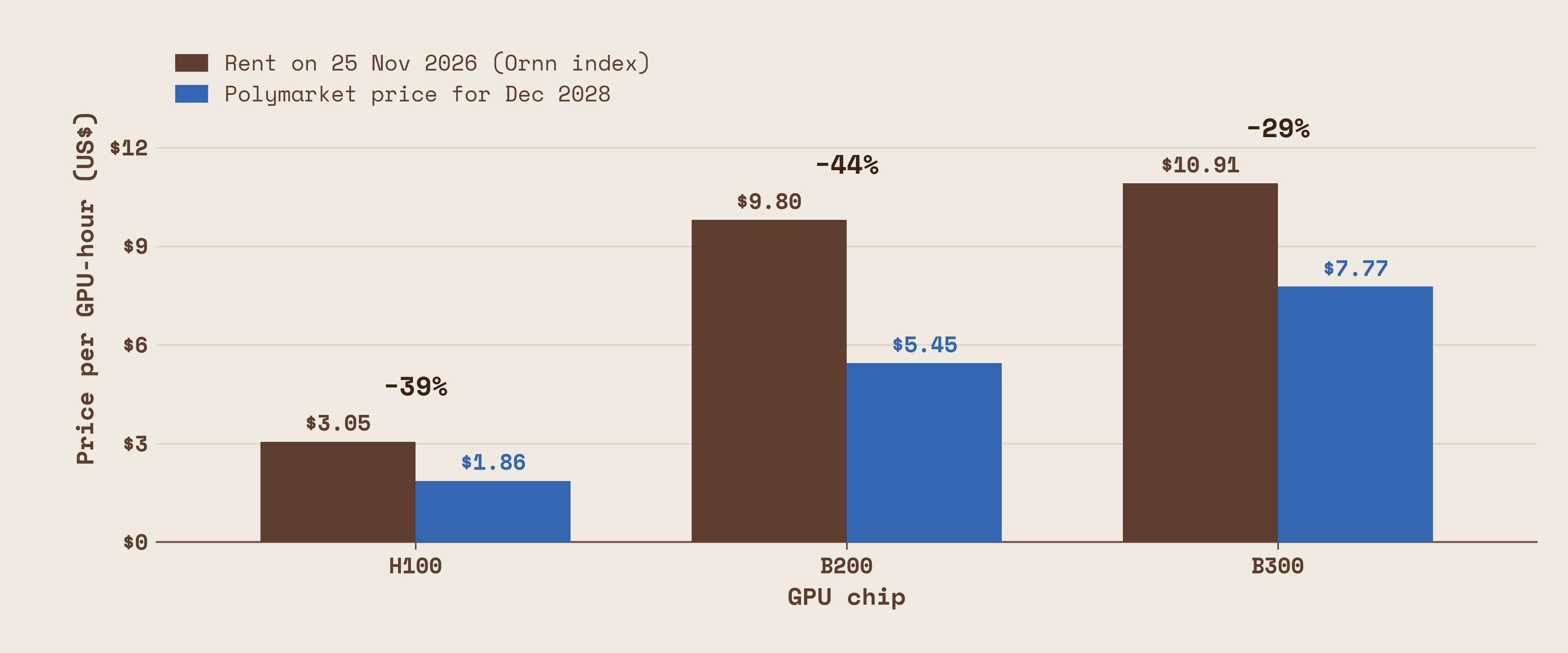
Fig. 5. Hourly rent for one chip on Ornn's index on 25 November 2026, compared to the price Polymarket's traders give even odds for December 2028. Source: The Prediction.
Neoclouds, cloud companies like CoreWeave ($CRWV ( ▼ 0.07% )) and Lambda that buy chips and rent them out, have the most riding on those prices. They borrow to buy the chips and repay the loans out of rent.
82% of the curve's notional volume is on the nearest contracts, December 2026 to March 2027, and $0.2M is on December 2028.
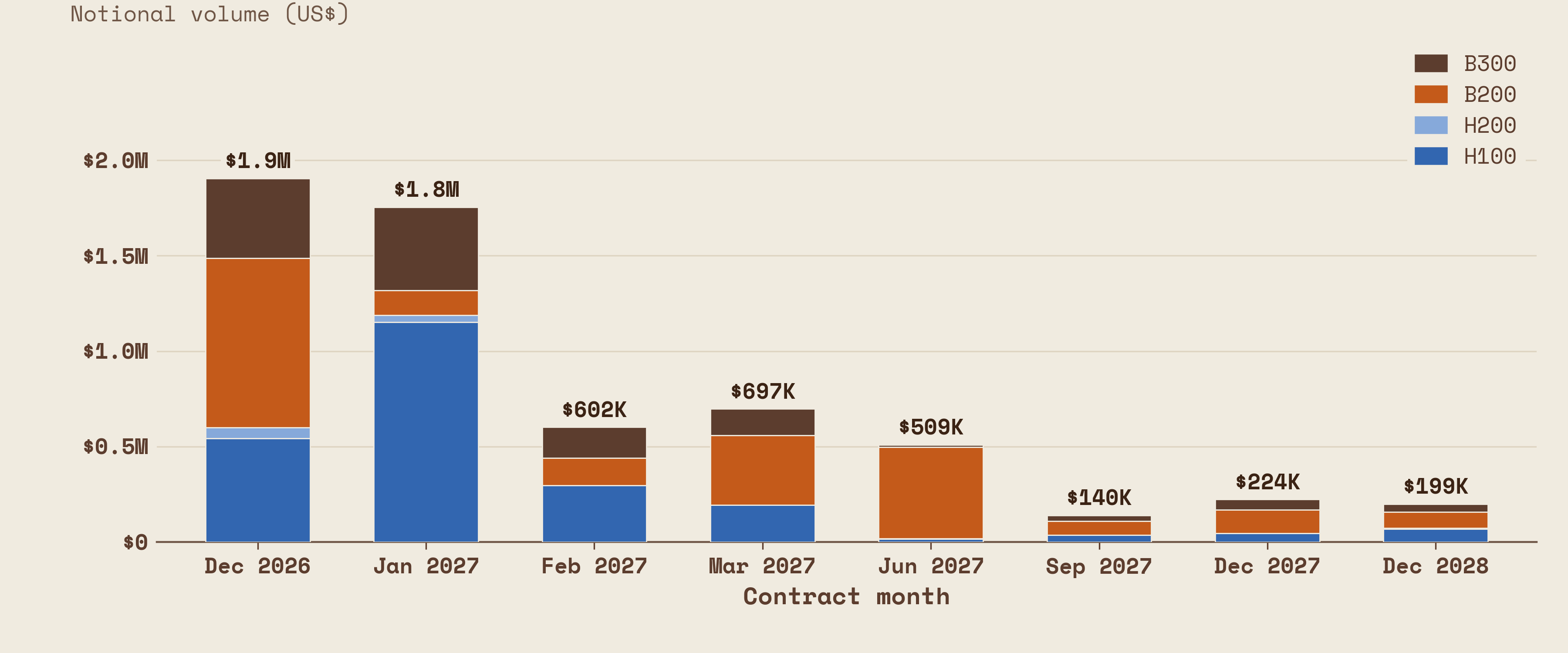
Fig. 6. Notional volume on Polymarket's compute curve by contract month and chip, 23 November 2026 to 26 November 2026. Source: The Prediction.
Our read is that a lender to a neocloud would want to hedge a fall in rents like this, but the 2028 prices rest on very little trading so far.
05 - AI model bets are still bigger
The best-AI-model markets, judged by a public leaderboard that ranks models on user votes, came to about $235M of notional volume on Kalshi and Polymarket International between January 2026 and October 2026, 20x the $11.8M on compute markets.
They have cooled on Polymarket International, down 77% from $26.1M in April 2026 to $6.1M in October 2026, while the exchange as a whole fell 40%. On Kalshi, they have held at between $4.1M and $7.0M a month.
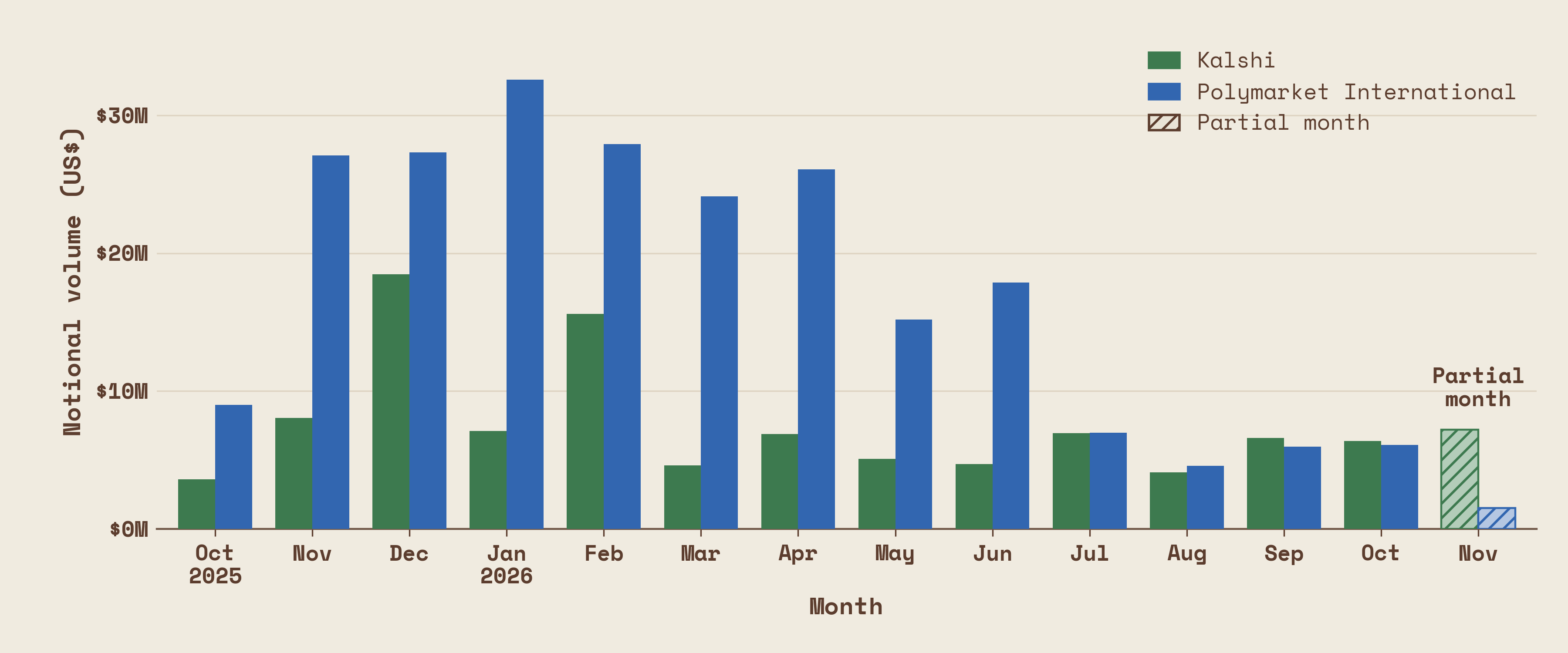
Fig. 7. Monthly notional volume of best-AI-model markets on Kalshi and Polymarket's international exchange. November 2026 is a partial month. Source: The Prediction.
Our read is that people come to AI markets for a monthly answer they can follow on a leaderboard, and compute markets need companies that pay for chips to start hedging.
06 - How big could compute markets get
Amazon ($AMZN ( ▲ 3.55% )), Alphabet ($GOOGL ( ▼ 0.02% )), Microsoft ($MSFT ( ▲ 0.2% )) and Meta ($META ( ▲ 3.71% )) plan to spend about $730B on capital expenditure (capex) in 2026, much of it on the chips, if we go by guidance from their Q3 2026 results. Compute markets on Kalshi and Polymarket traded $11.8M from January 2026 to October 2026.
CME ($CME ( ▼ 0.05% )) and Silicon Data announced futures on H100 and B200 rental prices in August 2026, due to launch on 5 October 2026.
The CFTC has pushed its review back twice, now to 8 January 2027.
Intercontinental Exchange ($ICE ( ▲ 0.1% )) and Ornn announced their own compute futures in May 2026, but have not given a launch date.
Those futures work differently compared to what Kalshi and Polymarket offer.
Let’s work through an example.
If an AI lab is worried that chip rent will go up.
On Polymarket, it can buy "Yes" on H100 rent averaging above $3.50 an hour in March 2027. If rent averages above that, the lab gets $1 for each contract, and if not, it gets nothing. Hedging their exposure.
A CME future is closer to fixing the price. The lab gains a little for every cent rent rises and loses a little for every cent it falls, and CME stands in the middle to make sure both sides pay. That is how big companies and their banks already lock in the price of oil and power, currently.
Bloomberg Law reported last week that Kalshi plans to relist its rental markets and then add futures, with a CFTC decision expected in early 2027.
In October 2026, Jump Trading, which backs Silicon Data alongside DRW, hired Affaan Mustafa and Alejandro Soumah Fernandez, the founders of compute-trading startup Itô, to run a new compute trading desk.
The desk trades with Jump's own money across private deals, perpetual futures (contracts with no expiry date) and prediction markets, and plans to make markets in CME's compute futures once they launch.
DRW are putting traders and capital into compute contracts as well.
Our read is that compute trading will pick up in 2027, and it is still unclear whether that happens on prediction markets or on futures exchanges. But the demand is there. And currently, it feels that the forward curves being developed on prediction markets feel ‘simpler’. And hedging compute might not become mainstream in 2027. But it might be mainstream for almost every tech-enabled business in 2037. So hedging against the volatility in compute price is something that will happen in the future. Prediction Markets are most certainly going to be a venue that attracts some of that action.
07 - What we are watching
Whether daily trading on Polymarket's curve stays above $1M.
Whether compute markets close the gap on AI-model markets, which drew 20x more money between January 2026 and October 2026.
Whether CME's compute futures launch after the CFTC review ends on 8 January 2027, giving the same hedge a home on a traditional exchange.
Disclaimers
This newsletter is for informational purposes only and is not financial, business or legal advice. These are the author's thoughts & opinions and do not represent the opinions of any other person, business, entity or sponsor. Any companies, platforms, markets or projects mentioned are for illustrative purposes unless specified.
The contents of this newsletter should not be used in any public or private domain without the express permission of the author.
The contents of this newsletter should not be used for any commercial activity, for example - research report, consultancy activity, or paywalled article without the express permission of the author.
Please note, the services and products advertised by our sponsors (by use of terminology such as but not limited to; supported by, sponsored by or brought to you by) in this newsletter carry inherent risks and should not be regarded as completely safe or risk-free. Third-party entities provide these services and products, and we do not control, endorse, or guarantee the accuracy, efficacy, or safety of their offerings.
When you trade on prediction markets (including event contracts, opinion markets and other speculative instruments) your capital is at risk. Risks include price volatility, loss of capital, illiquidity, complexity, evolving regulation and lack of protection. Many prediction market operators do not currently operate in a fully regulated industry, and availability varies by jurisdiction. You may not be protected under financial compensation schemes typically afforded to investors dealing with regulated entities. Nothing in this newsletter constitutes a recommendation to place, hold, or close any position on any market.
